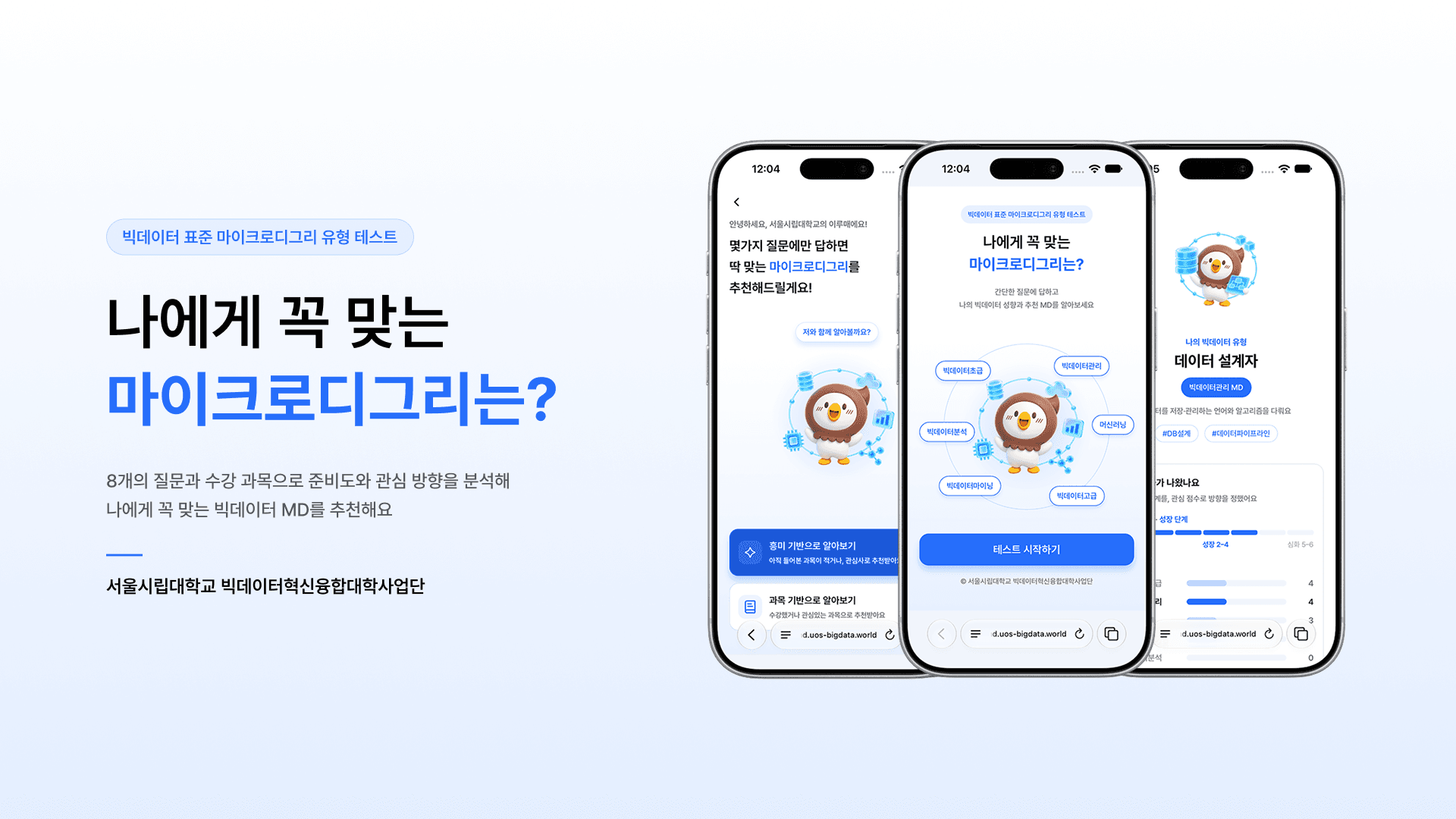

This project is the big data micro-degree (MD) type test app used at a booth run by the University of Seoul Big Data Innovation Convergence University Program at the university's 2026 major fair.
1. Overview
The Big Data Innovation Convergence University Program runs micro-degree (MD) courses, which certify students who complete a designated set of courses.
There are six standard big data MDs alone — Big Data Basic, Big Data Management, Big Data Analysis, Machine Learning, Big Data Mining, and Big Data Advanced — plus 16 department-specific linked convergence MDs on top of that.
But the details — which courses count toward which MD, substitute courses, old course numbers, and whether a course is offered this semester — were scattered across a guide PDF more than 30 pages long, which made it hard for students to figure out which MD suited them on their own.
So I built a mobile web test that students could open right away from a QR code at the booth, get an MD recommendation within two minutes, and see which courses to take next.
The test can be taken in one of two ways.
| Mode | For | How it recommends |
|---|---|---|
| Interest-based | Underclassmen and non-majors who haven't taken any courses yet | Calculates readiness and interest scores from 8 scenario-based questions to recommend an MD |
| Course-based | Upperclassmen and majors who have already taken related courses | Calculates progress (n/4) for each MD from the courses checked, and recommends the one quickest to finish |
The result screen shows the recommended MD along with a roadmap of remaining courses, MDs that can be earned together with just a few more courses, progress toward the student's department-linked MD, and how to apply.
2. System Architecture
I built this project with React, Vite, and TypeScript, and styled it with CSS variable tokens and CSS Modules.
Everything runs in the browser, with no login, no server, and no personal data collected, and all state is managed with a single useReducer instead of a separate state library.
Since MD eligibility has to be determined by course number rather than course name, I organized the course data into "slots," each grouping a main course with its substitute courses and old course numbers.
The six standard MDs come down to 26 slots in total, and a single slot can count toward several MDs at once.
{ "id": "dl", "name": "딥러닝", "main": "47768", "md": ["분석", "머신러닝", "마이닝"], "group": "ai" }
Courses, slots, questions, and linked convergence MD data all live in separate JSON files so that no course numbers are hard-coded. When the semester changes, only the list of offered courses in term.json needs to be replaced, so the app can keep being used semester after semester, well beyond the event.
The "MDs to earn together" feature pairs the recommended MD with each other MD and finds the minimum number of additional courses needed to bring both to 4/4. With only 20 on-campus slots, an exhaustive search over combinations is more than fast enough, so I implemented it to check every combination while increasing the course count k one at a time.
for (let k = Math.max(needA, needB); k <= cand.length; k++) {
  let best: Slot[] | null = null
  let bestScore = -1
  for (const c of combos(cand, k)) {
    if (c.filter((s) => s.md.includes(a)).length < needA) continue
    if (c.filter((s) => s.md.includes(b)).length < needB) continue
    const score = c.filter((s) => tierOf(s) === 0).length * 10 + c.reduce((n, s) => n + s.md.length, 0)
    if (score > bestScore) {
      best = c
      bestScore = score
    }
  }
  if (best) return { k, needA, needB, slots: [...best].sort(recSort) }
}
I wrote the matching logic as pure functions separate from React and covered it with golden tests in Vitest. For the interest-based mode, I exhaustively computed all 65,536 (4⁸) answer combinations to verify that the six results come out evenly, each between 15.0% and 18.8%.
Beyond that, I used html-to-image so users can save their result card as an image, and tracked user counts and events with Google Analytics.
3. Retrospective
Rather than jumping straight into development, I first wrote a planning document covering the screen flow, questions and scoring, result screen, and edge cases, along with a document of implementation rules. I then validated the matching logic with an HTML prototype and developed the app together with a coding agent.
Having the plan and rules written down gave me a clear standard for reviewing what the agent produced, and the golden tests let me immediately check that the matching logic hadn't broken as I wired up the screens.
While moving the PDF guide into data, I also found five places where things didn't line up — the same course listed with different numbers on different pages, or mismatched department and MD names — plus one rule the PDF never defined.
Instead of making those calls myself, I organized them into a list to confirm with the program, each with a temporary handling, and it taught me that for a service that delivers results based on data, verifying the source material matters just as much as development.
Finally, since the test result is only ever a recommendation, I made sure the result screen always states that final recognition is confirmed by the program based on course numbers. It taught me that when building a service that delivers information to users, it's just as important to make clear the limits of what the service can stand behind.